
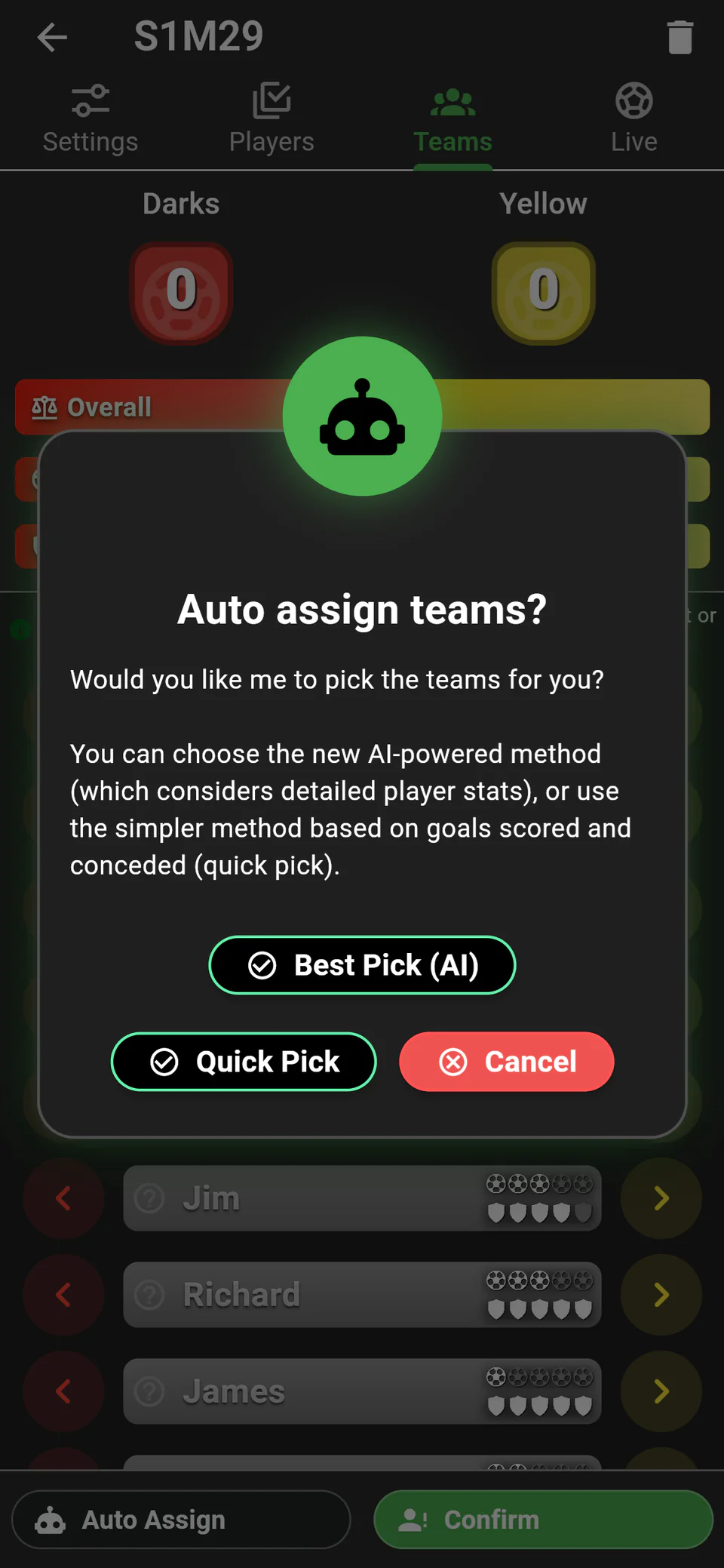
Pick fair casual-football teams by confirming the available players first, balancing the strongest players across both sides, accounting for defenders and goalkeepers, using recent match evidence, and then making a small human adjustment for anything the data cannot know.
What “fair” should mean
A fair split does not guarantee a draw. Small-sided football is noisy: confidence, effort, combinations and a single goalkeeper can change the score. The useful test is whether both sides had a plausible chance before kick-off.
For most weekly groups, fairness has three parts:
- Overall ability: neither side receives most of the strongest players.
- Shape: both sides have somebody willing to defend, create and finish.
- Current context: injuries, fitness and a player’s recent improvement are reflected.
A practical balancing method
Start only after availability is final
Do not spend time balancing provisional names. Confirm the players and promote any reserves first. One late change can affect every pairing.
Separate obvious outliers
If two players are consistently the strongest, put one on each side. Do the same with specialist goalkeepers or the only two natural defenders. This removes the largest imbalance before considering the rest.
Use more than goals
Goals are visible but incomplete. Results when a player participates, attack and defence indicators, attendance, assists and the quality of previous team-mates all add context. Avoid treating one unusually high-scoring game as a permanent rating.
Compare the whole sides
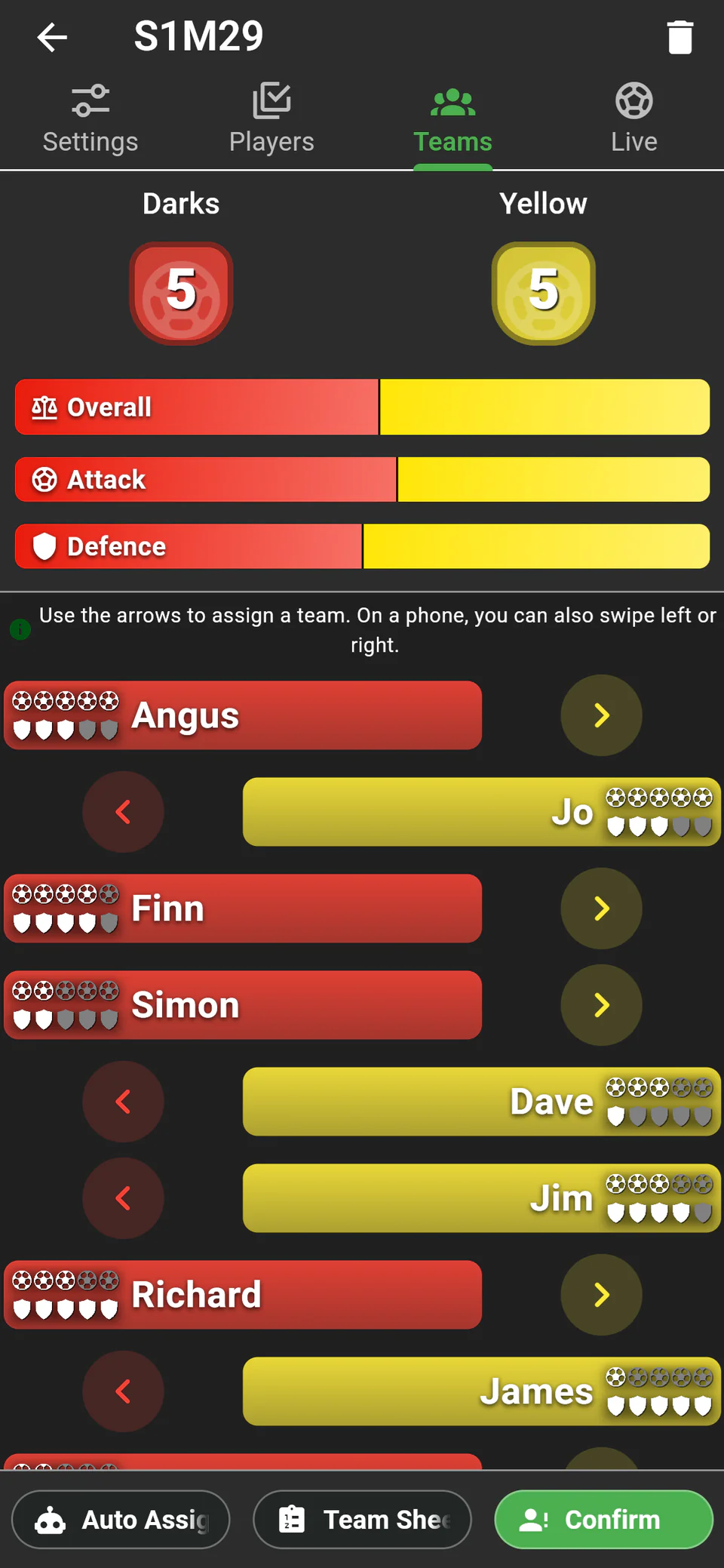
A team of individually strong attackers can still be unbalanced if nobody tracks back. Compare attack, defence and overall strength, then inspect the actual combinations.
Apply the organiser’s context last
The app cannot know that somebody is returning from injury, that two players both want a turn in goal, or that a new player has been underestimated. Make those adjustments after the evidence-based split, not before it.
Captains, random teams or automatic balance?
Captains picking uses local knowledge but can be slow and uncomfortable for the last players selected. Random teams feel neutral but frequently produce obvious mismatches. Automatic balancing is consistent and removes some social pressure, but it works best with enough match history and an organiser’s final review.
A useful compromise is to generate a balanced suggestion, let the organiser inspect it, make at most one or two justified changes, and then share it as final.
Make the recommendations better over time
- Record who actually played on each side.
- Save every final score, including one-sided games.
- Add goals and assists only if they can be recorded reasonably accurately.
- Do not rewrite past results to make current ratings look right.
- Review surprising suggestions rather than automatically rejecting them.
The quality of a balancing system depends on the quality and quantity of the group’s own evidence. A new group will need more organiser judgement; an established group can lean more heavily on its history.
Where Our League fits
Our League is built for the group whose teams change each week. It is not a line-up tool for one fixed club playing another fixed club. Available players form two temporary sides, and the app can compare their attack, defence and overall strength before kick-off.
Give next week a fairer start.
Add the available players, generate a balanced suggestion and keep control of the final teams.
Try team balancing free