
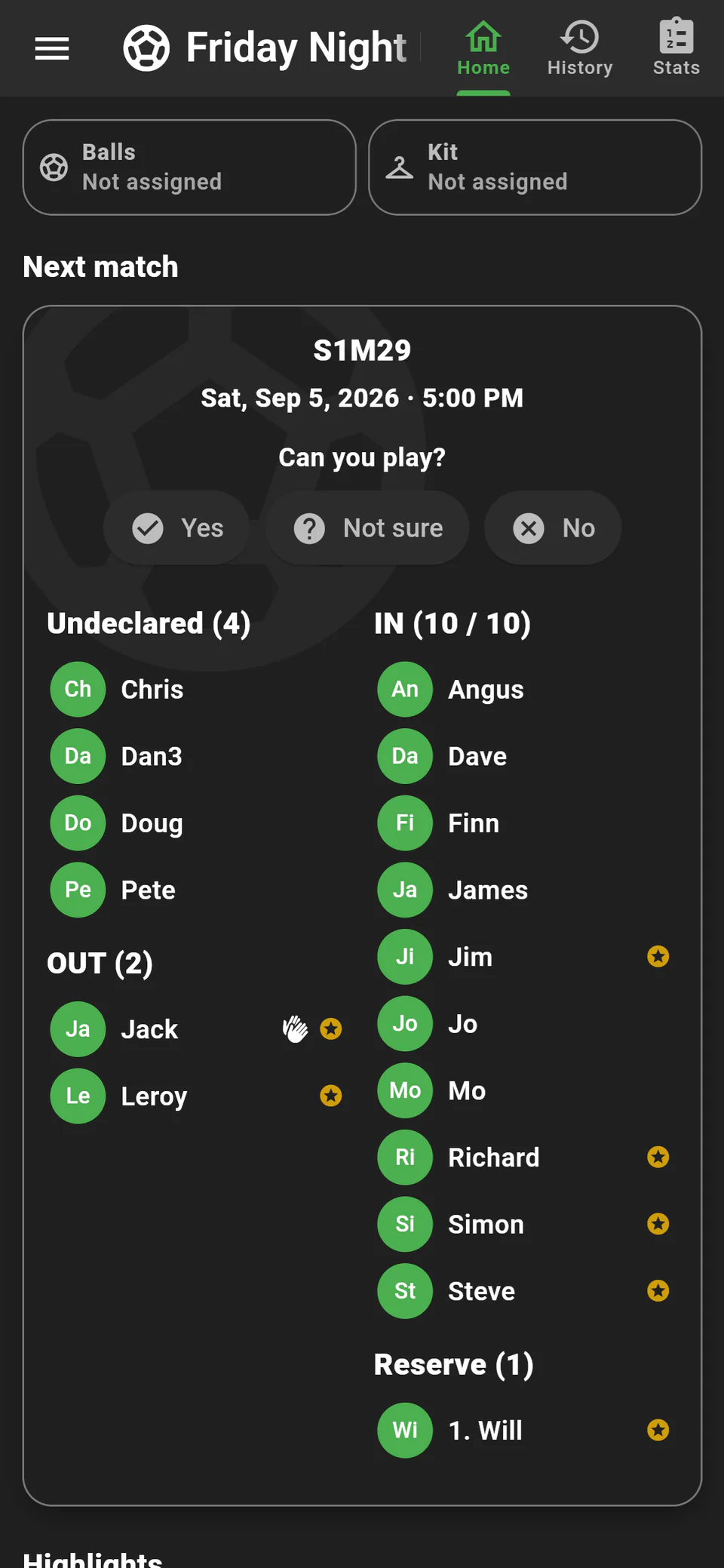
Manage weekly-football availability by publishing the fixture with a player limit and deadline, requiring each player to choose in, out or undecided, placing extra players on an ordered reserve list, and promoting the first reserve whenever a confirmed player withdraws.
Use one list as the source of truth
The hardest availability problems are usually not caused by too few replies. They are caused by several different versions of the list. The organiser has a note, the chat has a poll, somebody replied privately and another player assumes last week’s answer still counts.
Choose one place that determines whether somebody has a spot. Messages can explain a situation, but they should not silently change the list.
Use statuses that mean different things
- In: the player intends to attend and occupies a place.
- Out: the player will not attend and should not be chased again.
- Undecided: the player has seen the fixture but cannot yet commit.
- Reserve: the player wants to play, but the confirmed player limit has been reached.
Do not count “undecided” as confirmed. If the group needs ten players, it has ten only when ten people are marked in.
Agree the reserve policy before the game fills
The least contentious approach is usually first confirmed, first served, followed by an ordered reserve list. If a confirmed player withdraws, the first reserve receives the place. If that person cannot take it, move to the next.
Some groups prioritise regular players or rotate places. That can work too, provided the rule is visible before decisions are made. A policy invented after the list fills will feel personal.
Set two deadlines, not one
The response deadline
Choose a point when undecided players must commit or release the place. This gives reserves enough notice to plan.
The late-withdrawal expectation
After teams are shared, players should contact the group as well as updating their status. The goal is not to punish unavoidable withdrawals; it is to give the replacement the best possible chance of arriving.
Move the work away from the organiser
Players should update their own availability. The organiser’s job is to publish the fixture, enforce the agreed rules and resolve genuine exceptions—not to message every silent player individually.
A recurring schedule also helps. When the same day and time appear automatically, availability becomes a routine rather than a new administrative event.
Use attendance history carefully
Attendance can identify patterns, but it should not become a public punishment table. Use it to understand whether the group needs more reserves, a different response deadline or a larger regular-player pool. Occasional absences are normal; repeated no-shows without an update are a process problem worth addressing privately.
How Our League handles it
Players can set their own match status while organisers see the confirmed players and reserve list in one place. Player limits prevent accidental overbooking, and recurring weekly schedules reduce repetitive setup.
This is designed for an existing casual group. It does not automatically find unknown replacement players nearby; the reserve list is made from the people already connected to your group.
Replace the weekly headcount.
Publish the next fixture and give every player one clear place to answer.
Set up your group free